
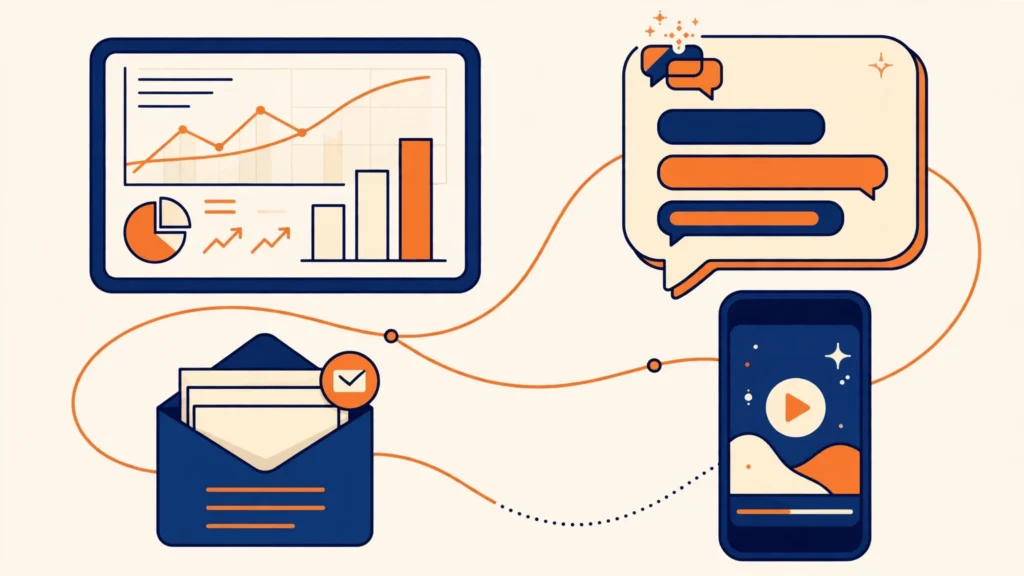
The biggest change in marketing right now is not a new platform. It is a new gatekeeper: AI answers. The digital marketing trends 2026 that matter most all connect to one shift, discovery moving from ten blue links to AI-generated answers, short video feeds, and private communities. This guide breaks down the ten digital marketing trends 2026 will be defined by, and what each one means for businesses that cannot afford to waste a marketing budget.
Short answer: the defining digital marketing trends 2026 brings are AI search changing how brands get found, AI content raising the value of genuine human experience, short-form video as the default format, first-party data replacing rented audiences, and trust becoming a ranking and buying factor everywhere. Brands that adapt their content for AI answers and build owned audiences will grow; brands still writing only for ten blue links will quietly lose visibility.
Digital marketing trends 2026 at a glance
| Trend | What is changing | First move |
|---|---|---|
| AI search and answer engines | Buyers get answers before they click | Structure content so AI can cite it |
| AI content, human proof | Generic content is now free and endless | Add real experience, data and faces |
| Short-form video everywhere | Video is the default content format | Turn every article into clips |
| Search beyond Google | TikTok, YouTube and Reddit act as search engines | Publish where your buyers search |
| First-party data returns | Third-party tracking keeps shrinking | Grow an email list you own |
| Creators and social commerce | People buy from people inside apps | Partner with niche creators |
| AI automation in ads and email | Campaigns optimise themselves | Feed platforms better creative |
| Conversational and voice search | Questions get longer and more natural | Answer questions in plain language |
| Retail media and connected TV | Ad money follows shopping and streaming | Test small budgets early |
| Trust as a growth channel | Reviews and reputation decide close calls | Collect and show proof publicly |
1. AI search rewrites how brands get discovered
The most important of all digital marketing trends 2026 is the rise of answer engines. Google AI Overviews, ChatGPT, Perplexity and similar tools now answer questions directly, which means a growing share of searches end without a click. Visibility no longer means only ranking on page one; it means being the source an AI answer cites. Pages that state clear facts, answer the question in the first lines, and organise information with tables and direct headings are far easier for these systems to quote. Marketers call this work AEO and GEO, and it is becoming a standard part of SEO rather than a separate experiment. Google’s own research hub, Think with Google, has tracked this shift in consumer behaviour for several years.
2. AI content floods in, so human proof gets valuable
When every competitor can generate fifty articles a day, generic content stops being an advantage. What AI cannot produce is your experience: your numbers, your mistakes, your customers’ real outcomes, your face on camera. Expect the content that wins in 2026 to carry visible proof, original data, first-person testing and named authors with real credentials. This is also why heavy-handed AI text detectors keep missing the point; readers and search engines alike reward content that demonstrates experience, whatever tools helped draft it, a debate playing out around tools like the undetectable AI humanizer category.
3. Short-form video becomes the default format
Short vertical video is no longer a social media extra. It is the first format most audiences meet a brand in, across TikTok, YouTube Shorts, and Instagram Reels at the same time. Among the digital marketing trends 2026 offers, this is the most practical one for small teams: one good article can become three short clips, one clip can become a week of posts, and every clip is another doorway into the business. Brands that still treat video as a quarterly project will look invisible next to competitors who publish weekly.
4. Search spreads beyond Google
Younger buyers increasingly start product research on TikTok and YouTube, check opinions on Reddit, and ask AI assistants before they ever open a classic search engine. That does not make Google irrelevant; it makes single-channel SEO a risk. The practical response is repurposing with intent: the same expertise published as an article for Google, a short video for TikTok and YouTube, and a genuinely helpful answer where your buyers discuss the problem. Discovery is fragmenting, and the brands present in more of the fragments win more of the demand.
5. First-party data and email come back to the centre
Years of privacy changes have steadily weakened third-party tracking, and that direction continues through 2026. The marketers least hurt by every platform change are the ones who own their audience: an email list, a customer database, a community. Expect renewed investment in lead magnets, newsletters, and onboarding sequences, the unglamorous assets that keep working when an ad account or algorithm changes overnight. Of all the current digital marketing trends 2026 will reward, this is the one with the longest shelf life.
6. Creators and social commerce keep merging
People increasingly buy inside the apps where they already spend time, and they buy from people they recognise. Creator partnerships are shifting from one-off sponsored posts to long-term arrangements where a creator becomes the face of a product line, while platforms keep adding native checkout so the path from video to purchase never leaves the app. For small brands, one niche creator with a loyal audience usually outperforms a celebrity mention at a hundred times the price.
7. AI runs more of the advertising itself
Ad platforms now automate targeting, bidding, and much of the creative testing. The marketer’s job is moving up a level: supplying strong creative, clean conversion data, and clear guardrails, then judging what the machines produce. Teams that feed platforms weak creative and messy data get automated mediocrity. This is also why classic skills still compound; disciplined fundamentals like ethical SEO link building and honest analytics matter more, not less, when the machines do the clicking.
8. Conversational and voice search keep growing
Questions typed into AI assistants and spoken to phones are longer and more natural than old keyword searches. Content written in keyword fragments reads worse to humans and answers worse for machines. The pages that perform are the ones that state real questions as headings and answer them in plain, direct language, which is precisely the format answer engines prefer to quote. Writing the way a knowledgeable person speaks is quietly becoming a technical SEO skill.
9. Retail media and connected TV take more budget
Advertising money follows attention, and attention sits with shopping platforms and streaming television. Retail media networks let brands advertise at the digital shelf edge, and connected TV puts video ads in living rooms with digital targeting. These channels were once enterprise territory; falling entry costs are bringing them within reach of mid-size brands through 2026. The sensible move is small, measured tests while prices are still reasonable.
10. Trust becomes a visible growth channel
When AI can generate unlimited claims, buyers look for proof. Reviews, case studies with real names, transparent pricing, and founders who show their faces are converting better than polished anonymous branding. Several of the top digital marketing trends 2026 point the same way: in a market flooded with generated content, verifiable honesty is a differentiator. Brands should treat review collection and public proof as a marketing channel with an owner and a target, not an afterthought.
How to prepare for the digital marketing trends 2026 brings
Start with the discovery shift, because it affects everything else. Take your ten most important pages and make each one answer its question in the first lines, with clear headings, honest facts, and a table or list an AI can quote. In parallel, build the owned audience: one useful lead magnet and a consistent email habit will outlast any algorithm. Then fix the format gap by turning your best existing content into short video before creating anything new. None of this requires a bigger budget. It requires aiming the existing budget at where attention and answers now live.
Frequently asked questions
What are the biggest digital marketing trends in 2026?
The biggest digital marketing trends 2026 brings are AI search and answer engines changing discovery, AI-generated content raising the value of human experience and proof, short-form video as the default format, first-party data replacing rented audiences, and trust signals deciding more purchases. Together they reward brands that publish clear, provable expertise in more than one format.
Is SEO dead in 2026?
No. SEO is expanding rather than dying. Ranking in classic results still matters, but visibility now also means being cited inside AI answers, which marketers call AEO and GEO. The fundamentals, clear structure, genuine expertise, and trustworthy sources, serve both goals at once.
Where is AI having the biggest effect first?
It is rewiring both ends of the buying journey. Shoppers increasingly ask a chatbot for a shortlist before they open a single website, and the teams selling to them lean on the same tools to draft copy, plan campaigns and read the numbers. The winners are brands that publish plain, checkable facts an AI answer can quote with confidence, backed by customer evidence no model can fake.
What should a small business do first about these trends?
Fix discovery first: make your key pages answer their question immediately, in plain language an AI answer can quote. Then start or grow an email list you own, and turn your best content into short-form video. Those three moves cover the most important digital marketing trends 2026 offers without new ad spend.
Will email marketing still work in 2026?
Yes, and its value is rising. As platform reach and third-party tracking shrink, an email list is one of the few audiences a business fully owns. Consistent, useful emails outperform occasional promotions, and they keep working regardless of algorithm changes.
Final thoughts
None of these ten shifts asks you to start over. They ask you to aim what you already do at where attention and trust now live: answers instead of links, proof instead of claims, audiences you own instead of reach you rent. Pick the two trends closest to your customers, fix those properly this quarter, and ignore the rest until they are done. In 2026 the loudest brand rarely wins; the clearest one does.